knowledge library / Irregular-Shaped Rugs: How Designers Use Shape to Define a Space
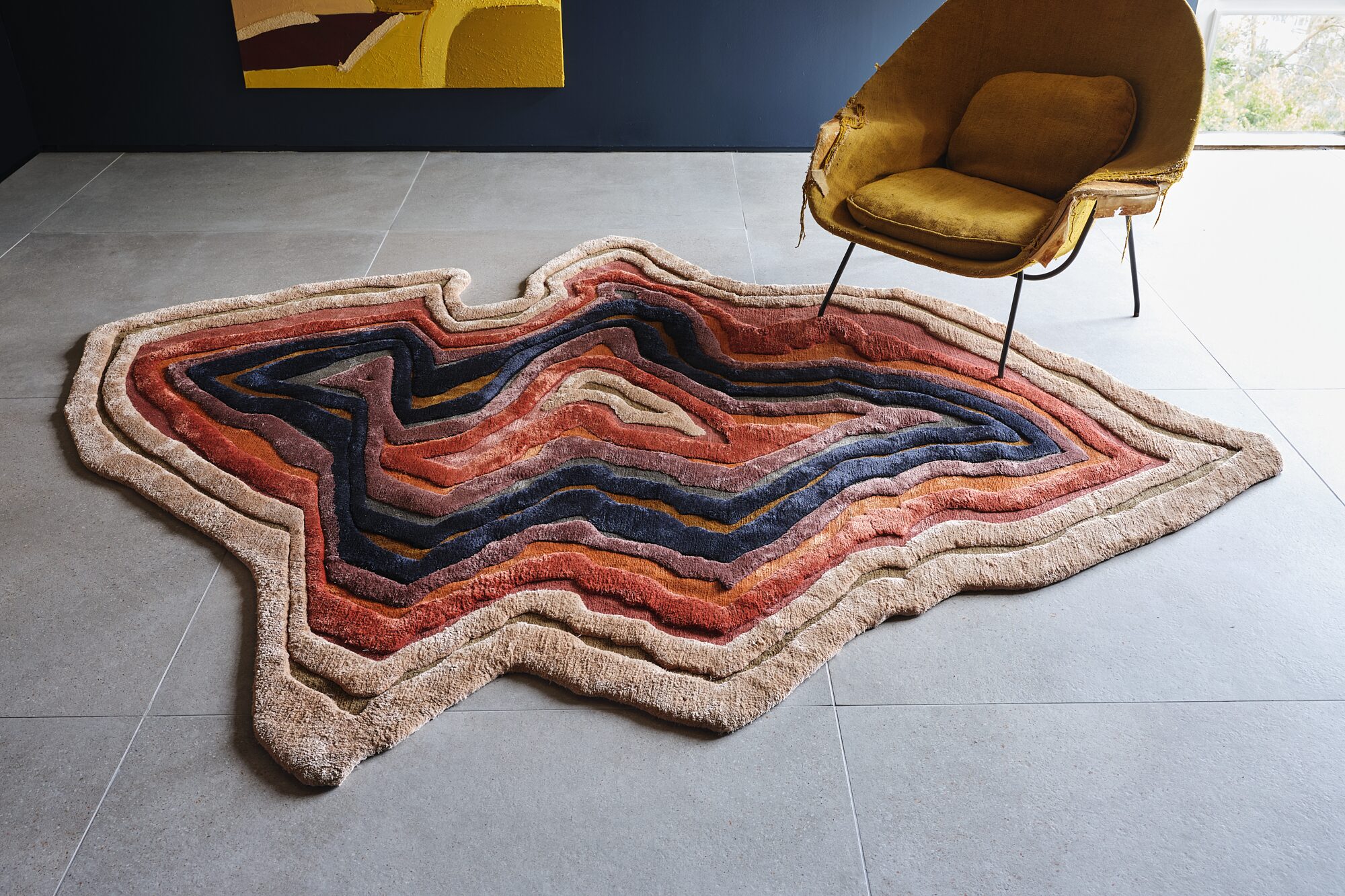
Irregular-shaped rugs define space by replacing the neutral perimeter of a rectangle with an active line. Curves can soften rigid architecture, asymmetry can direct attention, and cut-ins can accommodate furniture or circulation. The shape works best when it answers a real condition in the room; without that relationship, an unconventional outline can feel decorative, undersized, or difficult to place.
“Irregular” covers several different ideas: organic or freeform contours, asymmetric geometric outlines, scalloped or lobed edges, notched forms, and composite silhouettes built from overlapping shapes. A round or oval rug is nonrectangular but still regular and centered; an irregular rug changes direction, balance, or radius along its perimeter.
What is an irregular-shaped rug?
An irregular-shaped rug is a rug whose outline does not follow a standard rectangle, square, circle, or oval. Its perimeter may curve, taper, step, project, recede, or combine several geometries, making the edge an intentional part of the design.
The outline may come from the design itself, from the physical character of a material, or from a shape developed for a particular floor plan. Natural hide rugs demonstrate material-led irregularity, while a designed silhouette can be precisely drawn and repeated. WOVEN's Ora series uses curves and untraditional silhouettes as the central design language rather than treating them as incidental trimming.
An irregular outline is not the same as an irregular pattern. A rectangular rug can contain energetic arcs, offset blocks, or abstract motifs while maintaining a conventional edge. Conversely, a shaped rug can use a quiet solid color and allow the perimeter to carry nearly all of the visual movement.
How does an irregular rug define a space?
An irregular rug defines space by making its boundary selective. A rectangle tends to establish one stable field; a shaped rug can widen around a seating group, narrow near circulation, pull toward a view, or create a visual pause between architectural zones.
A useful design review reads a shaped rug in three ways: as a field that holds furniture, as a line that directs the eye, and as negative space that reveals the floor around it. A successful outline coordinates all three. The rug should feel deliberate from the main approach to the room, not only from a single photograph or viewpoint.
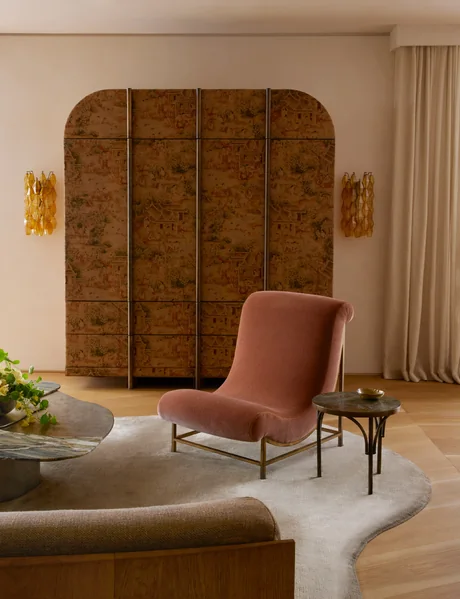
Curves often soften a room dominated by orthogonal walls, millwork, and furniture. Angled or stepped edges can reinforce diagonal architecture or establish a new direction. An asymmetrical projection can pull a small chair, side table, or artwork into a larger composition without expanding the rug equally on every side.
Which irregular rug shapes solve different design problems?
Different irregular shapes solve different spatial problems. The best outline follows the room's geometry closely enough to feel connected while retaining enough independence to read as an intentional object.
| Shape family | Spatial role and watchpoint |
|---|---|
| Organic or freeform curve | Useful for: Softening rectilinear rooms, gathering loosely arranged seating, or creating a calm counterpoint to hard architecture. Watch: A vague blob with no relationship to furniture, views, or circulation can feel arbitrary. |
| Asymmetrical geometric | Useful for: Reinforcing angled walls, offset furniture, diagonal sightlines, or dynamic modern compositions. Watch: Too many competing angles can make the floor plan feel unsettled. |
| Scalloped or lobed | Useful for: Repeating rounded furniture, creating rhythm along an exposed edge, or giving a small zone a distinct identity. Watch: Deep lobes increase exposed edge length and can complicate furniture placement and padding. |
| Notched or cut-in | Useful for: Responding to columns, built-ins, hearths, cabinetry, or a circulation channel without shrinking the entire rug. Watch: Tight inside corners require clear production tolerances and careful installation. |
| Composite or linked form | Useful for: Connecting adjacent furniture groups or expressing several related centers within one composition. Watch: Narrow bridges and isolated projections may receive uneven wear or appear visually fragile. |
Material-led shapes form another category. WOVEN's hide rug collection shows how naturally varied outlines can introduce texture and asymmetry without pretending to be geometrically exact. Their material, construction, care, sourcing, and project suitability should still be evaluated individually.
When is an irregular rug better than a rectangular rug?
An irregular rug is better than a rectangular rug when the standard perimeter creates a spatial problem that shape can resolve. It should improve the floor plan, reveal architecture, or organize furniture more precisely rather than serve only as an attention device.
Three conditions make a shaped rug especially useful. First, the room has a meaningful nonrectilinear condition: a curved wall, angled bay, column, stair, or offset opening. Second, the furniture forms a loose or asymmetrical group that a rectangle either misses or overwhelms. Third, the rug needs to establish one zone within a larger open plan without implying a full room-sized rectangle.
A rectangular rug remains the stronger choice when the room needs visual calm, the furniture plan is symmetrical, multiple doors restrict placement, or the project requires easy future relocation. Unconventional shape introduces commitment: orientation, furniture, padding, and negative space become more specific.
Compare the shaped outline with a simpler alternative
Draw a rectangular or oval alternative beside the proposed irregular outline on the same furniture plan. Hold the furniture, circulation requirements and key viewpoints constant. The shaped version earns its place when a specific improvement remains visible after furniture covers part of the rug, rather than only in an empty plan.
Consider a hypothetical seating group beside a curved wall. A rectangle might hold every chair comfortably while leaving an awkward wedge of exposed floor. A broad curve could improve that relationship, but a deeper cut-in might leave a chair partly unsupported. The useful choice is the outline that resolves the floor and furniture together; copying the wall’s curve is not enough.
Record the reason for the selected perimeter, the strongest reason to retain the simpler alternative, and any furniture or site change that would reopen the decision. Review the entry, seated view and reverse approach. This is a comparison method, not a documented WOVEN installation.
How should an irregular rug work with living-room furniture?
An irregular living-room rug should hold the primary seating relationship even if it does not sit beneath every piece equally. The outline may extend toward a chaise, curve around a table, or release floor near a route, but the composition still needs a recognizable center.
Begin with the sofa, principal chairs, and coffee table rather than the rug shape. Decide which furniture legs need contact with the rug and which can sit entirely beyond it. Avoid narrow tips that barely catch one leg, deep cut-ins that isolate a chair, or exposed projections that appear disconnected from the seating group.
The most useful asymmetry is legible. A projection might align with the long side of a sectional, a rounded edge might echo a curved sofa, or a taper might open circulation toward a doorway. WOVEN's broader Studio WOVEN collection offers a useful context for comparing how outline, internal geometry, color, and texture can each carry part of a room's composition.
Can irregular rugs work in dining rooms and bedrooms?
Irregular rugs can work in dining rooms and bedrooms, but the shape must respect repetitive furniture movement. The visual outline cannot compromise the continuous floor area needed for chairs, bed access, or circulation.
Dining rooms need a generous continuous field
An irregular dining rug should support the table and every chair through the full pull-back path. Deep concave edges, narrow lobes, and abrupt notches near chair movement can create uneven contact and make the composition feel undersized. A softly expanded oval, broad asymmetric field, or shallow scallop is usually easier to coordinate than a highly articulated outline.
Bedrooms can use shape more selectively
An irregular bedroom rug does not always need to sit symmetrically beneath the bed. A shaped form can occupy the exposed side and foot area, connect a lounge chair to the sleeping zone, or create a separate dressing moment. The rug should still provide comfortable, predictable landing areas where people step down and move around the bed.
How can an irregular rug shape guide circulation?
An irregular rug can guide circulation by opening its outline toward a route and concentrating material where people gather. A receding edge can preserve a passage; a directional taper can point toward a view or adjoining room; a rounded projection can signal a pause without becoming an obstruction.
The rug should not create a confusing sequence of exposed tips and narrow channels. Review every door swing, threshold, stair approach, cabinet opening, chair path, and dominant walking line. In public and commercial settings, the project team must also confirm applicable accessibility, egress, floor-transition, slip-resistance, fire, and installation requirements with the responsible professionals.
Stable installation matters wherever the rug has exposed curves, notches or projections. Review the actual perimeter rather than assuming every irregular shape has more edge than a rectangle of comparable area. Pad and attachment choices must suit the rug, floor and use, with the outline and edge support confirmed by the responsible supplier or installer.
Before treating a proposed outline as buildable, use the custom-shape specification guide to review construction, perimeter limits, and the approval drawing. A successful room composition still needs a feasible fabrication plan.
How do you measure for an irregular-shaped rug?
Measure for an irregular-shaped rug by documenting the room and testing the full outline at scale. Width and length alone cannot describe a freeform perimeter, its orientation, or its relationship to furniture and circulation.
- Draw the fixed architecture. Record walls, columns, hearths, built-ins, thresholds, doors, vents, floor outlets, and transitions.
- Place the furniture accurately. Include bases, legs, recline positions, chair pull-back, casters, and likely alternate arrangements.
- Mark required circulation. Trace primary walking paths, door maneuvering, and access to storage or equipment.
- Establish the rug's center and direction. Decide what the shape gathers and where it visually points.
- Draw the negative space. Evaluate the exposed floor around every curve, notch, and projection rather than focusing only on rug area.
- Template the perimeter on site. Use a full-scale paper, fabric, or low-tack floor-safe outline approved for the surface; view it from every approach and in photographs.
- Document orientation and coordinates. Record the bounding width and length as well as the complete outline, key offsets, radii or control points, scale, datum, face side and room orientation. Confirm pattern and pile direction where relevant; overall dimensions alone cannot define an asymmetric shape.
- Recheck after design development. Confirm the final furniture, construction, edge finish, pad, floor, tolerances, and installation method before production.
A freehand sketch can communicate intent, but it is not a production drawing. Complex curves, internal corners, symmetry decisions, and orientation need an agreed reference file and review process. Exact submission, sampling, templating, tolerance, and approval requirements depend on the maker and project.
How should pattern, color, and texture relate to the rug's outline?
Pattern, color, and texture should either reinforce the outline or give it room to lead. When the perimeter is already expressive, a restrained field can make the shape easier to read. When internal geometry is strong, the edge may need to simplify so the two systems do not compete.
Lines that terminate at the perimeter can emphasize a cut or curve; lines that ignore the edge can make the rug feel like a cropped fragment. Directional pile, carving, contrasting materials, and high-low construction can strengthen a silhouette but may also change how the edge appears in light and how furniture meets the surface.
Shape can also exist inside a conventional perimeter. The Elysian series uses elongated geometry and modernist abstraction to create space-defining compositions, illustrating how internal design can direct a room without requiring every rug to have an irregular outer edge.
What are the most common mistakes with irregular-shaped rugs?
The most common mistakes occur when novelty outruns the floor plan. A shaped rug should make the room easier to understand, not force furniture and circulation to work around an arbitrary silhouette.
- Starting with a shape before the furniture plan. The outline should respond to actual anchors, movement, and architecture.
- Making every edge expressive. One clear gesture is often stronger than many unrelated curves and notches.
- Ignoring negative space. Awkward slivers of exposed floor can make even a beautiful rug feel poorly fitted.
- Using narrow projections without support. Tips and bridges may shift, curl, or receive concentrated wear depending on construction and installation.
- Treating shape as a substitute for size. An irregular rug still needs enough area to hold its furniture group.
- Assuming any curve feels softer. Radius, proportion, placement, and repetition determine whether a curve calms or unsettles the room.
- Leaving padding until installation. The pad, floor compatibility, edge stability, and attachment strategy belong in the specification.
- Assuming handmade means customizable. Custom size, shape, material, color, construction, and lead time must each be confirmed.
How should you evaluate an irregular rug shape?
A useful way to evaluate an irregular rug shape is to ask whether the perimeter clarifies the room from each important viewpoint. Review it as a floor plan, furniture field, visual direction and physical object. The following prompts structure that design judgment without implying that a particular outline has received production approval.
- Boundary: What architectural or furniture condition does the outline answer?
- Center: What activity or grouping does the rug hold?
- Direction: Where do the curves, angles, or projections lead the eye and body?
- Negative space: Do the exposed floor shapes feel intentional from all approaches?
- Transition: How do the edges meet doors, pathways, furniture movement, and adjacent materials?
- Constructibility: Can the outline, edge finish, construction, pad, tolerances, and installation be resolved without weakening the design?
WOVEN's Shapes collection provides another way to study the relationship between organic material and geometric organization. Whether a shaped rug is selected from an existing collection or developed for a project, the strongest result makes its unconventional edge feel inevitable.
When should you choose an irregular-shaped rug?
Choose an irregular-shaped rug when its outline solves a specific spatial problem or creates a more coherent furniture composition than a standard shape. Define the center, circulation, negative space, and construction before committing. The right shaped rug does not merely occupy the floor; it edits the room, revealing where to gather, where to move, and what to notice.