knowledge library / How to Tell if a Rug Is Handmade: What to Look for in a Hand-Knotted Rug
The most reliable way to tell whether a rug is handmade is to inspect its construction, especially the reverse, foundation, pile attachment, ends, and edges. A hand-knotted rug shows rows of pile yarn wrapped around warp threads and secured by wefts, but no single clue is decisive. Fringe, irregularity, or a visible pattern on the back supports an identification only when the evidence agrees.
“Handmade” is a broad category. A rug may be hand-knotted, hand-tufted, handwoven without pile, hooked, braided, or made by another manual process. This guide focuses on recognizing hand-knotted construction and distinguishing it from other methods. It does not provide a shortcut for determining a rug's age, origin, authenticity, condition, rarity, or value.
What does “handmade rug” mean?
A handmade rug is constructed primarily through manual work, but the term does not identify one specific structure. Hand-knotted and hand-tufted rugs can both be handmade, as can kilims, soumaks, and other flatweaves. The useful question is therefore not only “Was this made by hand?” but “How was the surface attached to the foundation?”
That distinction matters because construction affects what can be seen from the reverse, how the rug handles, and which repair or care questions are relevant. It also prevents a common mistake: treating “handmade,” “handwoven,” and “hand-knotted” as interchangeable labels.
How is a hand-knotted rug constructed?
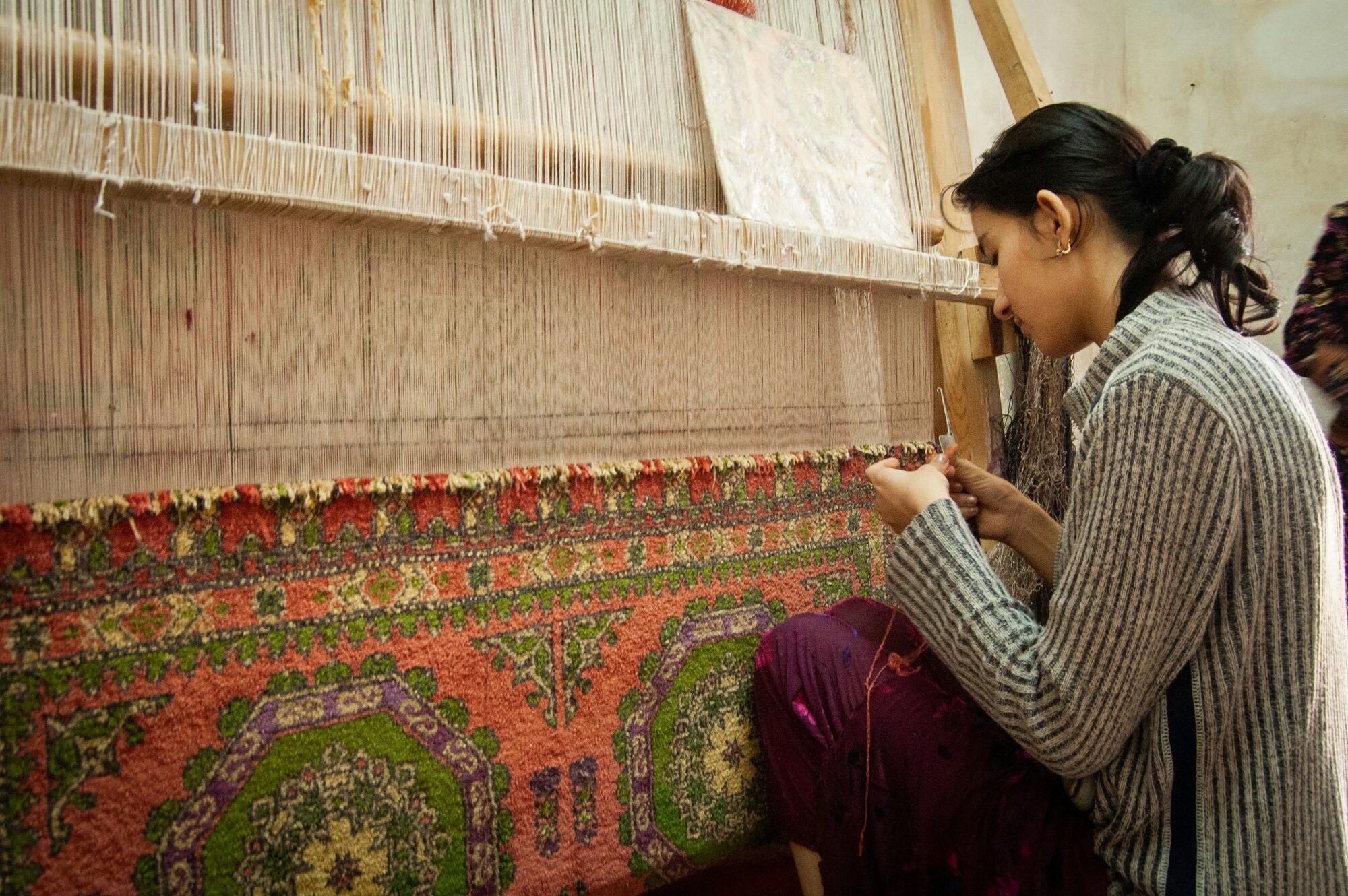
A hand-knotted rug is built on a foundation of warp and weft yarns. Warps run lengthwise under tension on the loom; wefts cross the width. Short lengths of pile yarn are wrapped around selected warps in rows, then held in place by one or more passes of weft. The projecting ends form the rug's pile after they are cut and finished.
The word “knot” is convenient trade language, although the pile yarn is more precisely wrapped around the warps and secured within the foundation. Symmetric and asymmetric knots are two common structures, but neither is exclusive to one country. Knot type can support a broader attribution; it cannot establish origin by itself.
Because the pattern is built into the same structure that forms the rug, the reverse of a hand-knotted rug usually reveals the design as a grid of colored knots and wefts. The back is often the most informative place to begin, but age, wear, heavy pile, repairs, depressed warps, and finishing can make the structure more difficult to read.
How do hand-knotted rugs compare with other constructions?
Hand-knotted rugs are distinguished by how the pile is integrated with the foundation, not merely by a handmade appearance. A hand-tufted rug can also involve extensive manual work, while a handmade flatweave has no knotted pile at all. Machine-woven rugs can imitate traditional patterns and even some surface variation.
| Construction | What the reverse may show | How the surface is formed | Ends and backing | Identification caution |
|---|---|---|---|---|
| Hand-knotted | Rows of colored knots and wefts; design usually legible | Pile yarn wrapped around warps and secured by wefts | Foundation normally visible; fringe may continue from the warps | Repairs, lining, wear, or dense structure can obscure the evidence |
| Hand-tufted | Backing fabric or an applied secondary backing often hides the design structure | Yarn inserted through a pre-existing backing rather than knotted around foundation warps | Applied backing and adhesive are common; fringe may be decorative or attached | Hand-tufted is handmade, but it is not hand-knotted |
| Machine-woven | Highly regular woven structure; the pattern may still be visible | Pile and foundation produced through mechanized weaving | Edges are often machine finished; fringe treatment varies | Regularity is evidence, not proof, and machines can simulate hand-knotted designs |
| Handmade flatweave | Interlaced warp and weft structure, often with a legible design on both sides | Weaving creates the surface without cut knotted pile | No pile backing is needed; ends and selvages are part of the woven structure | The rug may be entirely handmade even though there are no pile knots |
How can you inspect a rug for hand-knotted construction?
A reliable examination moves from the whole rug to increasingly close structural details. At WOVEN, we read the front and reverse together, then test the apparent construction against the foundation, pile, ends, edges, condition, and available documentation. The goal is a reasoned conclusion, not a verdict from one feature.
1. Examine the entire reverse
The reverse of a hand-knotted rug usually shows the design built from individual colored knot elements rather than printed color or pile inserted through a separate backing. Lay the rug on a clean surface and compare several areas, including the center, borders, corners, and any worn or repaired sections.
Do not judge only by whether the design is visible. Some machine-woven rugs also show a clear reverse, while a lining or secondary backing may conceal the structure of another rug. Look for how the design is made, not merely whether it appears on both sides.
2. Identify the foundation grid
The foundation grid consists of lengthwise warps and crosswise wefts. On the back of a hand-knotted rug, rows of pile knots alternate with weft passes that secure them. A small magnifier and angled light may help distinguish the knot collars, warp pairs, and horizontal wefts without disturbing the textile.
Some foundations are easy to read; others are compact, depressed, worn, or partly concealed. The number of wefts, the level of the warps, and the knot structure can vary among traditions. These differences are descriptive evidence, not a universal quality scale.
3. See how the pile joins the foundation
Hand-knotted pile is structurally connected to the warps. In a worn or low-pile area, it may be possible to see the two cut ends of a pile knot emerging from its wrap around the foundation. Compare several intact areas because repair, re-piling, and wear can create a misleading local picture.
A hand-tufted pile is inserted through a backing fabric and commonly secured by an adhesive and secondary backing. Avoid peeling, scraping, cutting, or pulling at the back to test it. A construction question never justifies damaging the rug.
4. Trace the fringe without pulling it
Fringe can support a hand-knotted identification when it is the visible continuation of the foundation warps. Follow a few fringe yarns visually into the body of the rug, but do not tug them. On many hand-knotted rugs, those lengthwise foundation yarns emerge at the ends and are secured or finished there.
Fringe is not conclusive. It may be replaced, shortened, overcast, concealed, or added decoratively. Some authentic hand-knotted rugs have no exposed fringe, while some machine-made rugs have attached fringe intended to suggest traditional construction.
5. Inspect the sides and end finishes
The sides and ends show how the foundation was stabilized after weaving. Look for selvages where weft yarns turn at the outer warps, as well as overcasting, binding, flatwoven end sections, or later repairs. Handmade finishing may show small shifts in tension and spacing while remaining deliberate and structurally coherent.
A machine-stitched edge is a useful clue, but it does not always identify how the rug's main body was made. Old sides may have been rebound, and handmade rugs can receive later machine repairs. Read finishing as one layer of the object's history.
6. Evaluate repetition and variation carefully
Variation can support evidence of hand production when it appears in knot spacing, drawing, color transitions, tension, or dimensions and remains consistent with the construction. Slight changes in a border repeat or a gradual band of color variation may reflect decisions made during weaving.
Irregularity alone does not prove handmade construction. Wear, distortion, repair, printing, finishing, and deliberate machine simulation can all produce variation. Conversely, a highly skilled hand-knotted rug may be remarkably regular. The meaningful question is whether the variation arises from the woven structure.
7. Compare the physical evidence with the description
A credible rug description should identify construction and materials separately from style, origin, age, and condition. Compare the seller's wording with what the object shows. “Persian-style,” for example, describes design influence and does not mean that a rug was made in Iran or made by hand.
When the rug is consequential because of price, age, claimed provenance, condition, or intended use, ask for clear front-and-reverse photographs and an examination by a qualified rug specialist. Fiber, dye, restoration, and exact attribution questions may require closer analysis than a basic construction check.
Which popular handmade-rug tests are misleading?
Popular handmade-rug tests become misleading when they turn one observation into a conclusion. The following clues may contribute to an examination, but none can establish hand-knotted construction alone.
- “The fringe proves it.” Fringe can be integral, replaced, concealed, or attached.
- “The pattern appears on the back.” Machine-woven rugs can also have a legible reverse.
- “The design is imperfect.” Handwork can be highly regular, and machine production can imitate variation.
- “The rug folds easily.” Handle depends on foundation, pile, density, materials, size, age, and condition.
- “A high knot count means handmade and valuable.” Knot count describes fineness; it does not independently prove method, quality, origin, age, condition, or value.
- “Burning a fiber reveals the answer.” A burn test can damage the rug and addresses fiber behavior, not the complete construction.
Can you tell whether a rug is handmade from photographs?
Photographs can support a preliminary construction opinion when they show the right evidence, but they may not support a definitive conclusion. Request a full front view, a full reverse view, close-ups of the back at a consistent scale, both ends, both sides, the pile at an oblique angle, and any repaired or worn areas.
Color correction, low resolution, heavy shadows, backing, and selective framing can conceal important clues. Photographs also cannot fully convey handle, foundation stiffness, pile direction, odor, active deterioration, or the difference between original structure and later restoration. Use remote review to decide what should be examined next, not to force certainty.
Does handmade or hand-knotted automatically mean better?
Handmade and hand-knotted describe how a rug was made; they do not automatically establish quality or suitability. Materials, drawing, execution, finishing, condition, repair history, pile height, density, and intended room use still matter. Ethical production, natural dyes, sustainability, durability, rarity, and value also require separate evidence.
WOVEN's antique rugs and antique Persian rugs offer many examples of hand-knotted construction, while the modern flatweave collection demonstrates why handmade should not be reduced to pile knots. WOVEN's contemporary rugs further show that construction is one design decision among material, texture, color, and scale.
What is the most reliable way to identify a handmade rug?
The most reliable method is to identify the structure and require several independent clues to agree. Begin with the reverse, find the foundation, determine how the pile or surface is attached, trace the ends and edges, account for repairs, and compare the evidence with the description. When the stakes are meaningful, finish with specialist inspection rather than a shortcut.