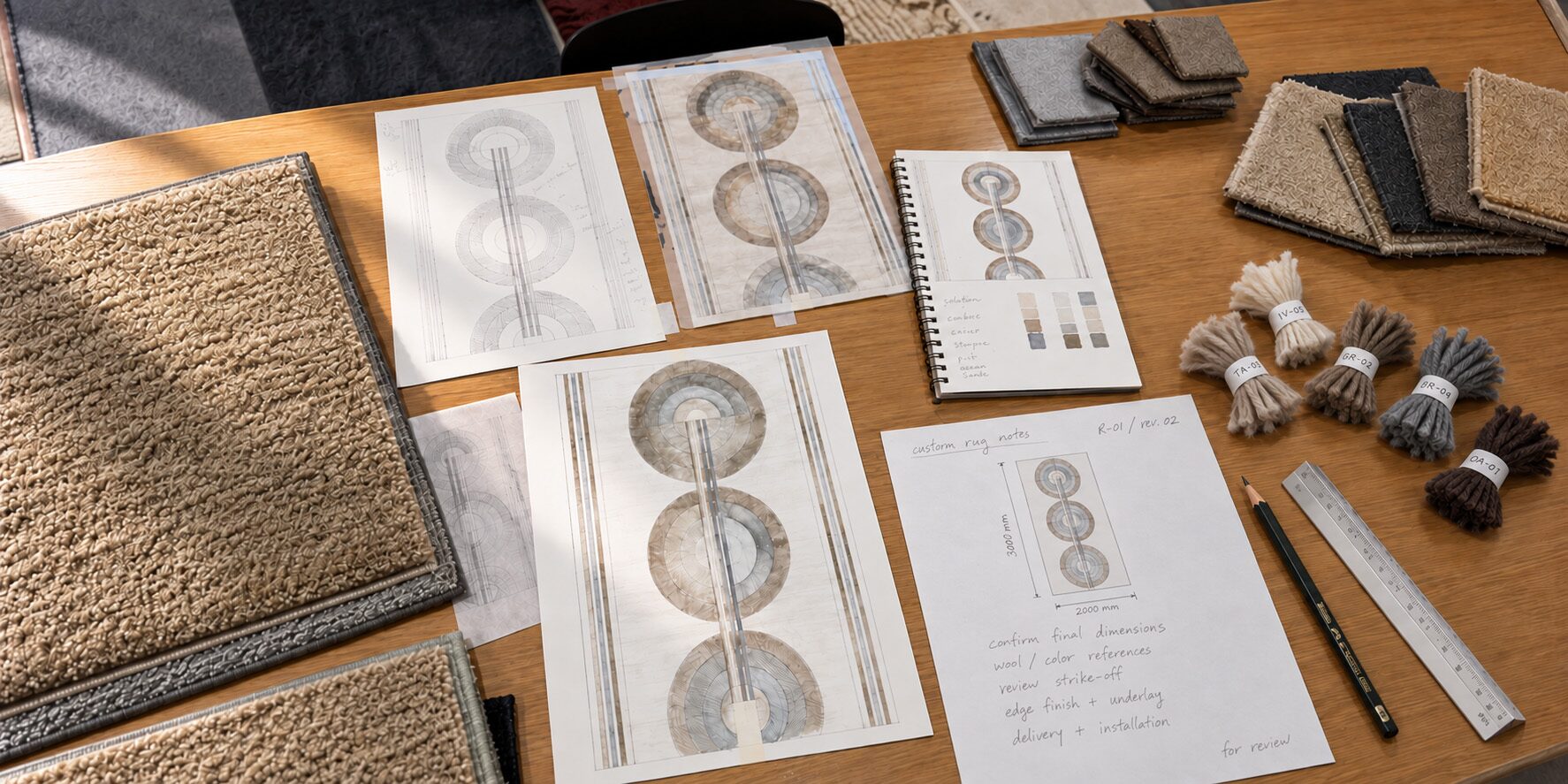
knowledge library / The Custom Rug Specification Checklist Interior Designers Can Actually Use
A usable custom rug specification defines five things before production: the room, the finished rug, the evidence the team will approve, the requirements the rug must meet, and the people responsible for each decision. The goal is not to predict every handmade variation. It is to replace avoidable ambiguity with a controlled, shared record.
What a custom rug specification must accomplish
A custom rug specification must translate design intent into information that can be drawn, sampled, priced, made, delivered, and checked. A phrase such as “soft ivory rug with an organic line” may be a useful beginning, but it does not define finished size, orientation, line scale, fiber, construction, pile, color reference, edge, tolerance, or approval standard.
For WOVEN, the useful distinction is between an inspiration and a specification. Inspiration describes the desired effect. A specification identifies what creates that effect, what evidence will represent it, and who can authorize the next step.
The checklist below is deliberately project-specific. Construction, materials, dimensions, tolerances, samples, testing, delivery, and installation should be confirmed for the individual rug rather than inferred from another project or a collection name.
The custom rug specification checklist at a glance
The most efficient custom rug checklist follows the rug through three states: plan, surface, and handoff. First, the rug must work as a dimensioned object in the floor plan. Second, its color, construction, and texture must create the intended surface. Third, the finished piece must move through the building, meet the site, and transfer into the client's care.
| Specification area | Minimum record | Release question |
|---|---|---|
| Project control | Project, room, contacts, decision roles, revision date | Does everyone know which document governs? |
| Room and use | Furniture plan, circulation, doors, traffic, light, floor, client needs | Is the rug appropriate for the actual setting? |
| Size and shape | Finished dimensions, orientation, datum, clearances, tolerance basis | Can the outline be located and checked? |
| Design | Artwork, scale, repeat, crop, motif placement, direction | Is the design represented at the intended rug scale? |
| Material and construction | Fiber, yarn, structure, pile, texture, carving, backing | Are surface and performance expectations tied to a buildable method? |
| Color | Color references, hierarchy, material context, approval light | Is each approved color connected to the yarn and construction in which it will appear? |
| Edges and floor interface | Edge/end finish, fringe, backing, underlay basis, total profile | Has the rug been coordinated with the floor and adjoining conditions? |
| Samples and approvals | Sample type, size, scope, limits, approver, status, date | Is it clear what each sample does and does not approve? |
| Commercial and project requirements | Budget basis, schedule milestones, testing/documentation needs, change rules | Are constraints visible before release? |
| Delivery and handoff | Packed form, route, access, installer, placement, inspection, care documents | Can the rug arrive, be placed, and be maintained as intended? |
1. Establish the project record and decision owners
Every custom rug specification should begin with a simple control block: project name, room, rug identifier, issue date, revision number, designer, client decision-maker, maker or vendor contact, purchasing party, ship-to location, and required decision dates. A rug described as “living room custom” is not identifiable enough once a project has several rooms, colorways, or revisions.
Name the person who can approve design, color, commercial terms, and production release. Those may be different people. Also state how approval must be recorded. A marked drawing, signed sample, dated email, or project-platform status can all work when the team agrees in advance; scattered comments across several channels cannot function as one reliable approval record.
2. Document the room before drawing the rug
The room record should show fixed architecture, the current furniture plan, circulation paths, door swings, floor transitions, floor finish, heat registers, built-ins, and any elements that determine the rug's position. Note the room's use, expected traffic, pets or children when relevant, maintenance expectations, and whether the client prioritizes softness, a low profile, visual quiet, pronounced texture, or another quality.
At WOVEN, we recommend reading the proposed rug at three distances: from the threshold, from the principal furniture position, and at close range. The threshold reveals overall proportion and direction. The furniture position shows how pattern and color interact with the room. Close range reveals pile, sheen, line quality, and texture. A specification should preserve the intended effect at all three distances.
Before developing custom, compare the brief with suitable contemporary rugs. An existing piece may solve the room with less development; if it does not, the comparison makes the custom requirements more precise.
3. Control finished size, shape, and orientation
Finished rug geometry should be documented on a dimensioned plan, not only as a length-by-width note. Record the finished-size basis, overall dimensions, shape, orientation, critical furniture relationships, exposed floor bands, door and threshold clearances, and a fixed datum from which placement can be checked.
For irregular outlines, include radii, coordinates, control points, or a maker-approved template method as appropriate. For patterned rugs, add a direction arrow and identify any motif that must align with a table, fireplace, axis, or room centerline. Ask the maker to state the applicable finished-size tolerance and how it is measured; do not copy a tolerance from a different construction or supplier.
Field conditions can change after early design drawings. Assign responsibility for final field verification and state when it must occur relative to production release. An approved shop drawing should consolidate the final outline, dimensions, direction, design placement, and revision status in one place.
4. Translate the artwork into rug-scale design information
Custom rug artwork must define more than an image. The specification should identify the governing artwork file and revision, final crop, motif scale, repeat or nonrepeat condition, border width, line thickness, asymmetry, negative space, and the treatment of details near the edge.
Review the design at full rug scale, even if it is printed or projected in sections. A line that feels decisive on a screen may become visually weak when enlarged, while a small detail may require simplification to remain legible in the selected yarn and construction. Where exact placement matters, dimension it. Where hand-drawn character matters, describe the acceptable character without turning natural variation into an unspecified excuse.
5. Specify material, construction, pile, and texture together
Material and construction should be selected as one surface system. Fiber identity alone does not determine the rug's appearance, hand, maintenance needs, or suitability. Record the fiber or fiber blend, yarn character, construction method, pile or profile, density or quality designation used by the maker, carving or relief, washing or finishing, backing, and any intentional variation.
Use physical references whenever texture carries the design. WOVEN's Solids and Textures collection can help a project team compare how changes in pile and yarn create different kinds of depth, while modern flatweaves provide useful low-profile points of comparison. These collections are visual references, not proof that every construction or material is available for every custom project.
Do not write “wool,” “silk,” “soft,” or “durable” as if each were a complete specification. Name the actual proposed material and construction, then ask what the combination means for shedding, crushing, shading, cleaning, furniture, rolling loads, pets, moisture, sunlight, and the expected use of that room.
6. Approve color in its material and construction
Custom rug color should be approved in yarn and in the proposed construction whenever color is critical. Record each color reference, its location in the artwork, its proportion or hierarchy, the material carrying it, the physical sample used for comparison, and the light conditions used for review.
Color is not independent of surface. Fiber sheen, yarn twist, pile direction, density, cut height, texture, and viewing angle can all change how a color reads. The same nominal color may appear quieter in a matte wool flatweave and more luminous in a cut silk pile. Review the sample flat on the floor, from more than one direction, and under the principal day and evening light conditions.
The approval record should also state what degree of handmade or material variation is expected and which differences would require a new review. Avoid using an uncalibrated screen image as the sole final color reference.
7. Define edges, ends, backing, and the floor interface
The rug's perimeter and underside are part of the design and should be specified with the face. Record the intended side finish, end finish, fringe or no-fringe condition, corner treatment, backing or no-backing condition, and any visible transition between pile heights or materials at the edge.
Coordinate the rug with the finished floor, underlay, doors, thresholds, furniture clearances, and adjacent surfaces. State who selects and supplies the underlay, whether it will be cut back from the rug edge, and what total profile can be accommodated. Compatibility with a particular floor finish should be confirmed by the relevant manufacturers or project specialists rather than assumed.
8. State exactly what each sample approves
A sample is useful only when its approval scope is explicit. The specification should identify whether the team is reviewing color, material, construction, pile height, carving, line definition, edge finish, backing, or a combination of these. Record the sample's dimensions, identifier, revision, submission date, decision, comments, approver, and retained reference.
A strike-off is evidence, not a miniature guarantee of every aspect of a full-size rug. Its usefulness depends on what it contains and how closely it represents the intended production method. If scale, repeat, motif placement, border proportion, or edge condition cannot be judged from the sample, those decisions need separate drawing or mock-up approval.
The approved sample and approved drawing should be read together. One controls the surface evidence; the other controls scale, geometry, and placement. If either changes, record the revision and identify whether the other approval is affected.
9. Record project, performance, schedule, and commercial requirements
Project requirements should be stated before the rug is released, even when the maker or vendor will respond with the final method. Record the room type, use conditions, applicable project specifications, requested test reports or certificates, accessibility concerns, indoor-air requirements, maintenance constraints, warranty expectations, and any client or jurisdictional criteria.
Do not treat a material name, handmade construction, or prior project as evidence of compliance. Testing and documentation must apply to the proposed rug and the current project's requirements. For hospitality or regulated settings, route questions to the project's qualified design, code, procurement, and installation professionals.
Record the accepted price basis, taxes or duties as applicable, freight basis, payment schedule, target milestones, approval deadlines, change procedure, cancellation terms, storage assumptions, and the event that authorizes production. Lead time should be tied to a clearly defined release point and current project information, not treated as a fixed property of all custom rugs.
10. Plan delivery, installation, inspection, and care before release
Delivery planning should begin while the rug is still on paper. Record the expected packed form and dimensions, weight if material to handling, receiving location, lift and stair constraints, door and corridor clearances, loading restrictions, protection requirements, storage conditions, installation date, installer, underlay, furniture sequence, and final placement reference.
Assign responsibility for site readiness, receiving, unpacking, placement, trimming or fitting of underlay, furniture movement, and disposal of packing materials. For large, shaped, or unusually delicate rugs, require a route review and installation plan appropriate to the project.
The handoff should include a condition check on arrival, photographs before furniture is placed, confirmation of finished dimensions and orientation when required, maker-specific care guidance, warranty or claim instructions, and the approved reference set. A custom rug is not fully specified if the team knows how it should look but not how it will enter the room or be cared for.
The five-part production-release test
A custom rug is ready for production only when the team can answer yes to five questions. This release test is more useful than asking whether the design is “final,” because it checks the dependencies around the design as well as the image itself.
- Frozen plan: Are the furniture plan, finished rug dimensions, shape, orientation, and critical clearances current and field-verified at the agreed stage?
- Defined surface: Are artwork, color, material, construction, pile, texture, carving, edges, and backing documented at a buildable level?
- Approved evidence: Are the controlling drawing and physical samples identified by revision, with the scope and limits of each approval recorded?
- Assigned responsibility: Are approvers, purchaser, field verifier, receiver, installer, and care recipient named, with changes routed through one controlled record?
- Ready site: Are access, floor condition, underlay, installation, inspection, maintenance, schedule, budget, and project requirements coordinated?
If one answer is no, the open item should appear on the release record with an owner and due date. “Proceed and resolve later” is not a neutral choice; it transfers a design question into production, where the options may be fewer and the consequences greater.
Common specification mistakes to correct early
The most common custom rug specification mistakes are not failures of taste. They are failures to connect a visual decision to a dimension, sample, responsibility, or site condition.
- Treating the mood board as the specification: Inspiration images communicate atmosphere but rarely control scale, construction, color, or finish.
- Approving color without its surface: A loose yarn pom or digital value cannot show every effect of pile, sheen, density, and direction.
- Using only overall dimensions: Size without orientation, datum, furniture relationships, and stated tolerance leaves placement unresolved.
- Assuming a sample approves everything: A strike-off may establish surface qualities while leaving full-scale motif placement or edge treatment untested.
- Leaving installation until delivery: Access, underlay, doors, floor condition, and furniture sequence can materially affect the final result.
- Allowing several “final” versions: Every drawing, artwork file, sample, and approval should carry an identifier and revision status.
A specification should make the next decision obvious
The best custom rug specification is not the longest document. It is the one that makes the next decision obvious and gives the team reliable evidence for making it. Define the rug as a plan object, a textile surface, and a delivered object; then release it only when the plan is frozen, the surface is defined, the evidence is approved, the responsibilities are assigned, and the site is ready.
WOVEN's STUDIO WOVEN collections show how line, color, material, and texture can work together as one rug language. A disciplined specification protects that unity as the concept moves from the design studio to the finished room.