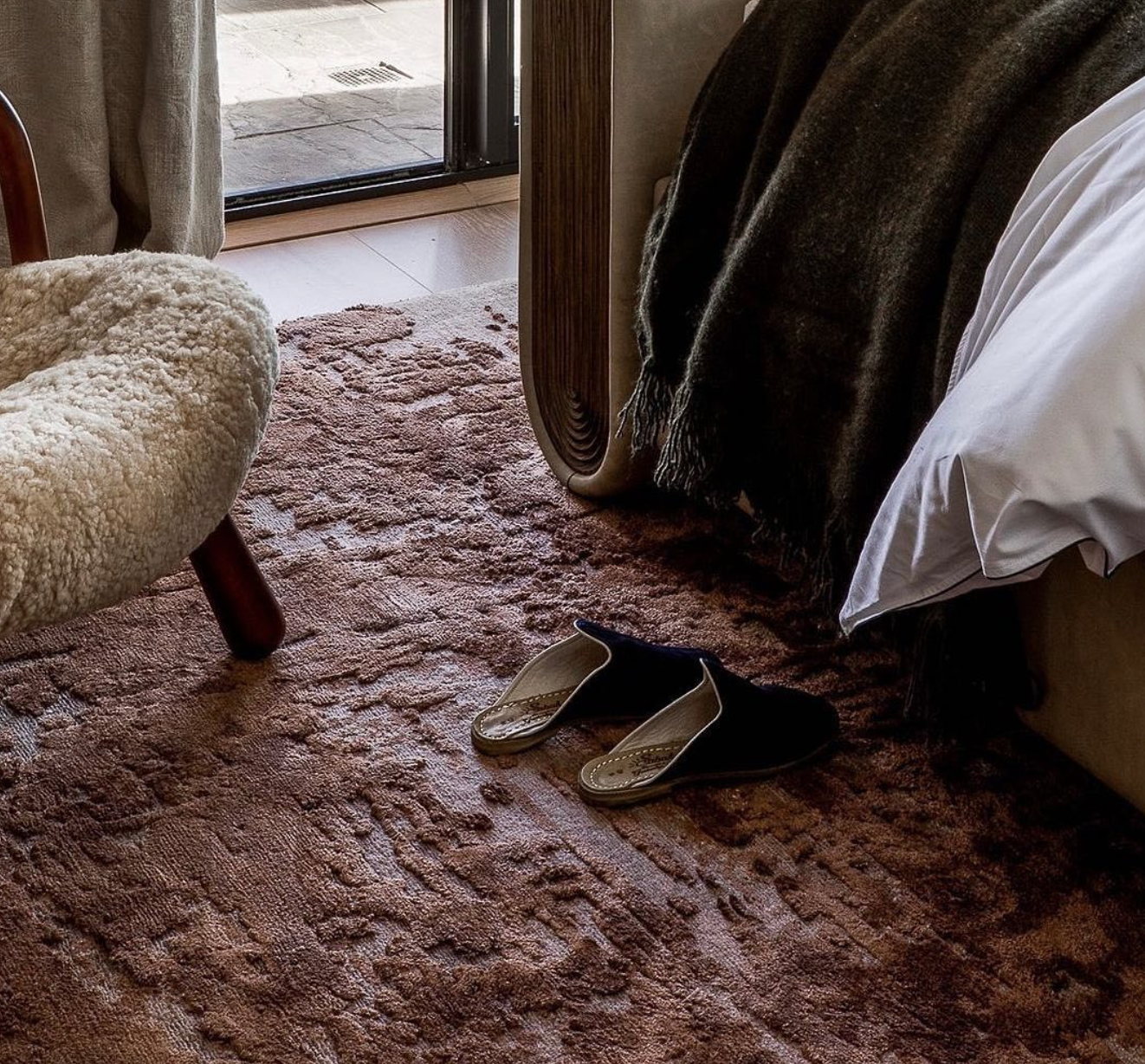
knowledge library / The Interior Designer's Guide to Commissioning a Custom Rug
A custom rug is worth commissioning when the room needs something more exact than available inventory can provide: a precise size, a particular palette, a quieter or bolder texture, an unusual shape, or a design that must respond to the architecture. The strongest commissions do not begin with a vague wish for something unique. They begin with a clear project brief and a disciplined sequence of decisions.
For designers, that sequence matters. A rug can set the scale of a room, soften circulation, balance upholstery and case goods, and establish the color temperature of an interior. When the piece is custom, every choice carries forward into sampling, approvals, production, delivery, installation, and long-term care. The goal is not to make every possible decision at once. It is to give the rug partner enough information to translate design intent into a rug that can actually live in the room.
When custom is the better choice
Custom is usually the right path when the project has a specific spatial or visual problem that an existing rug cannot solve cleanly. That might mean a long gallery runner, an overscale living room, a dining room where chair clearance is tight, a room with unusual architectural boundaries, or a palette that must sit precisely between stone, wood, upholstery, and art.
It may also be the better decision when the rug needs a particular surface: lower and more tailored, plush and atmospheric, matte and grounded, luminous and refined, or dimensional enough to hold a large room without relying on pattern. In those cases, the commission is not simply about choosing a color. It is about aligning scale, material, pile, texture, and construction with the way the room will be used.
An existing rug is still often the stronger choice when the design benefits from age, irregularity, one-of-one character, or the immediate presence of an antique or vintage piece. If a found rug already solves the room, forcing a custom alternative can flatten the project. The better question is not whether custom is more special. It is whether custom gives the room a better answer.
Start with the project brief
A useful custom-rug brief should make the room legible before anyone begins talking about yarn or pattern. At minimum, it should include the room type, final rug dimensions or the dimensional problem to solve, furniture plan, palette references, material preferences, use case, budget parameters, project schedule, and installation conditions.
Dimensions deserve particular care. Note whether the rug should sit under all furniture legs, stop just inside a seating group, clear a dining table and pulled-out chairs, follow a hallway, or create a softer zone within a larger room. If the final size is not known, share the floor plan and the decision criteria. A good rug partner can help test proportion, but only if the room constraints are visible.
Palette references should be more specific than a color name. A warm ivory, chalky white, oat, taupe, mushroom, gray, camel, or tobacco can shift dramatically next to the actual fabrics and finishes in the room. Include upholstery swatches, stone samples, wood finish references, paint colors, metal finishes, and any artwork or textile that must remain visually dominant.
The brief should also name the practical context: pets, children, entertaining, dining, bare feet, direct sun, stairs, rolling chairs, or a room that will be photographed more often than it is used. These details do not create a universal prescription, but they help narrow material, pile, construction, and care conversations.
Translate design intent into material and construction
Once the brief is clear, the commission moves into the language of fiber, weave, pile height, texture, and finish. Material is not only a performance decision. It changes how light moves across the room and how the rug feels underfoot.
Wool is often the most versatile starting point because it can feel tailored, dense, rustic, plush, or restrained depending on construction. Mohair can introduce softness and a natural sheen; silk can create luminosity and subtle movement; allo, linen, and hemp can bring a drier, more organic texture. Mixed materials can produce a more layered surface, where matte and luminous fibers temper one another.
Construction changes the atmosphere just as much as fiber. A flatweave or soumak texture can read architectural and low-profile. A sheared pile can feel more composed and refined. A tulu, shag, or higher-pile texture can make a bedroom, library, or sitting room feel more enveloping. Carving, pile variation, or high-low construction can add dimension without relying on a busy pattern.
The right choice depends on the room. A dining room may call for lower pile and easier chair movement. A primary bedroom may welcome a softer surface. A formal living room may need enough depth to feel luxurious without competing with upholstery. A hallway or stair condition should be reviewed with special care because movement, edge control, and installation details matter.
Use references carefully
Reference images are useful, but they should be treated as direction rather than instruction. A designer may bring an antique Oushak palette, a Studio WOVEN texture, a plaster wall, a landscape photograph, a textile fragment, or a previous project image. The role of the reference is to clarify the mood and hierarchy: quiet or expressive, tonal or contrasting, historical or contemporary, matte or luminous, structured or relaxed.
A strong custom process translates those references into choices that are appropriate to the room. A rug inspired by an antique may not need to reproduce one. A minimal rug may still need enough texture to hold scale. A pale rug may require subtle variation so it does not appear flat. A dramatic color may need restraint in pile or pattern so it can live with the furniture.
Plan for sampling, strike-offs, and approvals
Sampling is where the project becomes concrete. Depending on the commission, the design team may review yarn poms, color references, texture samples, construction samples, or a strike-off that shows a portion of the design at a smaller scale. This stage is not only a formality. It is the moment to test whether the rug's color, sheen, pile, and texture behave as intended next to the actual room materials.
Approvals should be handled with the same discipline as any other interior specification. Confirm who has authority to approve color, scale, design, construction, budget, and production release. If a client, designer, architect, purchasing agent, and contractor are all involved, decide early who resolves conflicting feedback. Too many late opinions can pull a rug away from the original design problem it was meant to solve.
Lead time should be discussed as a variable, not a promise. Material availability, construction method, complexity, size, sampling rounds, revision requests, production queue, shipping, site readiness, and installation coordination can all affect the schedule. Ask WOVEN to confirm a project-specific schedule that separates sampling, production, transit, and installation before committing to an arrival date.
Use the custom rug specification checklist to record the decisions and the sample and strike-off approval guide to define what each physical reference approves. Keep the approved drawing and sample versions together before releasing production.
Know what to review before production
Before a custom rug moves forward, the project team should review the approved dimensions, design direction, palette, material, construction, pile height, edge finish, backing or finishing details where applicable, installation condition, and care expectations. This is also the time to confirm whether the rug must coordinate with a pad, stair hardware, door clearances, built-ins, millwork, or furniture delivery.
For large projects, hospitality work, or residences with multiple rugs, a simple approval log can prevent confusion. Note the room name, rug size, approved sample or strike-off, final material, construction, revision date, approver, and unresolved conditions. This is less glamorous than choosing color, but it protects the design intent.
Delivery, installation, and care planning
The custom process should not end at production approval. Delivery and installation shape how the rug is experienced on day one. Confirm site access, elevator or stair conditions, receiving needs, rug pad decisions, furniture placement, and whether installers need a scaled plan. A large rug can be beautiful and still become difficult if the room is not ready for it.
Care planning should be specific to the material, construction, placement, and household or project conditions. Avoid treating all custom rugs alike. A lower-profile wool rug in a dining room, a silk or silk-blend rug in a formal space, and a high-pile mohair texture in a bedroom each invite different expectations. Cleaning, maintenance, rotation, sunlight, spills, and pad choice should be reviewed with the rug partner before installation.
Questions to ask before commissioning a custom rug
- What exact room problem should the rug solve?
- Is the desired size standard, overscale, irregular, or still dependent on furniture placement?
- Should the rug lead the palette, support the palette, or quietly disappear into the room?
- Which materials and textures are appropriate for the room's use?
- Is the project better served by custom work, an existing antique or vintage rug, or a contemporary piece already in inventory?
- What samples or strike-offs will the project team need before approval?
- Who has final approval authority?
- What schedule variables should be confirmed before production begins?
- What installation conditions could affect size, pad, clearance, or handling?
- What care guidance should be shared with the client before the rug is installed?
Where WOVEN fits into the process
WOVEN's perspective is shaped by two related practices: the curation of antique and vintage rugs and the development of Studio WOVEN, the in-house collection launched in 2016. That combination matters for custom work because it keeps the conversation grounded in both history and material experimentation. A custom rug can be contemporary without feeling generic; it can reference antique character without becoming a reproduction; it can solve a modern specification while still feeling made by hand.
For designers, the best starting point is a clear brief and an open conversation about whether the project calls for custom development, a Studio WOVEN texture, a contemporary rug, or a one-of-one antique or vintage piece. The right rug is not always the most complicated option. It is the one that resolves the room with proportion, material intelligence, and a surface the client can live with.
FAQ
How long does a custom rug take?
Lead time varies by material, construction, size, design complexity, sampling needs, production queue, shipping, and installation coordination. Ask WOVEN to confirm the schedule for the chosen design, including sampling, production, transit, and installation.
What should I bring to a first custom-rug conversation?
Bring the floor plan, target dimensions, furniture layout, room photos, palette references, material preferences, use case, budget parameters, and any installation conditions that could affect the final rug.
Can an antique rug be used as inspiration for a custom rug?
Yes, but the goal should be interpretation rather than imitation unless the project specifically calls for a reproduction-style approach. The most successful references clarify palette, scale, texture, mood, and character.
When should I choose an existing rug instead of custom?
Choose an existing rug when it already solves the room, when the project benefits from one-of-one age and character, or when the schedule does not allow for custom sampling and production.