knowledge library / Heriz vs. Serapi Rugs: What's the Difference?
Heriz and Serapi rugs belong to the same northwest Iranian design family, but the labels are used differently. Heriz is the broader name for carpets associated with the Heris area and market, spanning varied periods and qualities. Serapi is a narrower, historically inconsistent trade label usually applied to selected older Heriz-area carpets with spacious drawing and balanced color. It is not an official quality grade.
The boundary is interpretive rather than absolute. Dealers, collectors, and catalogs do not always apply “Serapi” in the same way, and two specialists may describe the same carpet differently. A responsible comparison therefore begins with label usage, then tests the name against the rug's drawing, structure, palette, age evidence, condition, and documented history.
What Is a Heriz Rug?
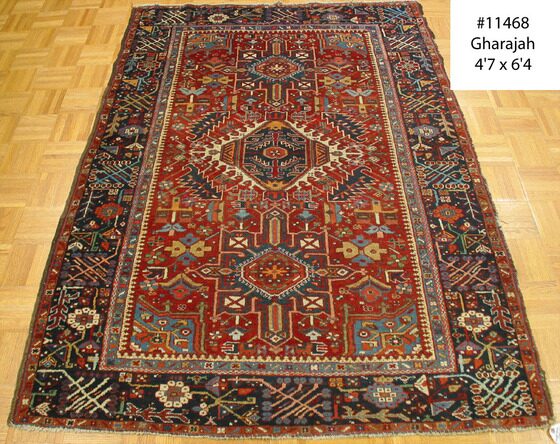
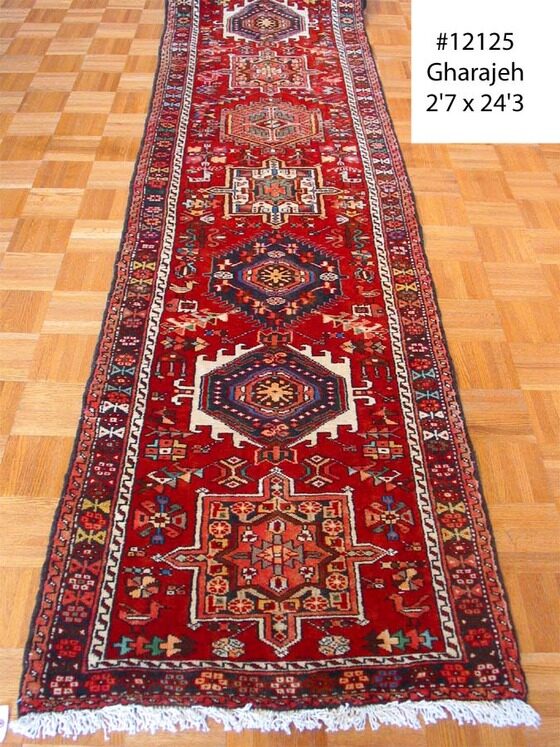
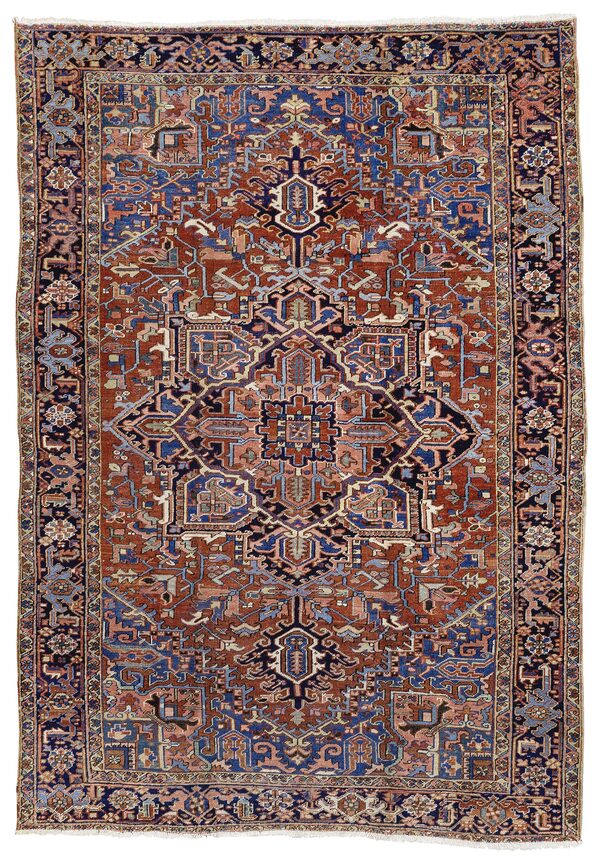
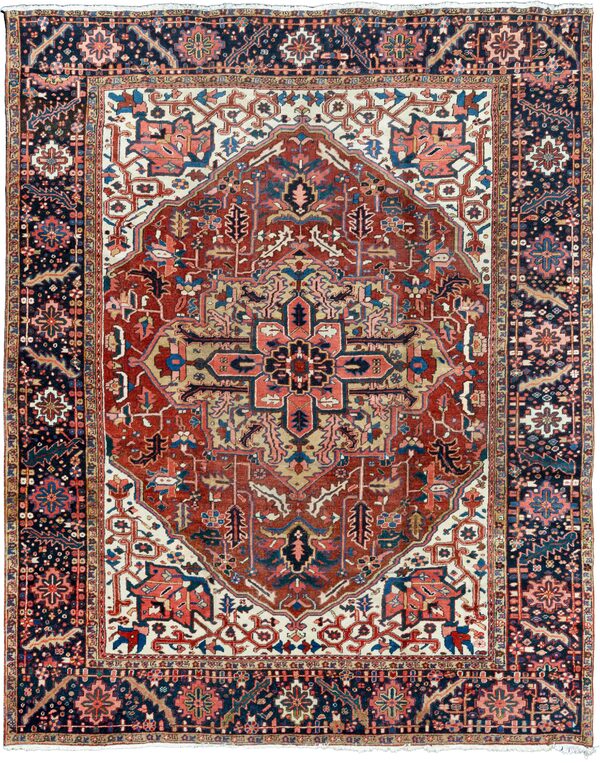
A Heriz rug is a Persian rug associated with the Heris weaving area in northwest Iran. Many examples are recognized by angular floral drawing, a prominent medallion, and a strong border, though the regional tradition is varied. Heriz identifies a geographic and market family; the name alone does not establish a rug's age, condition, materials, or quality.
When reading an example, look first at the relationship between the medallion, open field, and border, then examine the reverse and the documented attribution. A similar pattern can appear in a later interpretation. The visual family is a useful starting point for comparison, not a substitute for evidence about the individual rug.
Where do Heriz and Serapi rugs come from?
Heriz rugs are associated with the Heris weaving area in East Azerbaijan in northwest Iran, northeast of Tabriz. The broader region supported interconnected village, workshop, merchant, and wool-supply networks, so “Heriz” functions as both a geographic reference and a market category rather than the signature of one workshop.
Heriz carpets are widely recognized for angular medallion-and-corner compositions, geometricized floral drawing, emphatic outlines, and a strong architectural presence. Those tendencies are useful, but they are not exclusive. Heriz designs have been reinterpreted within and beyond Iran, and the production itself contains meaningful variation.
Serapi is usually understood within this Heriz-area context. In the rug trade, Serapi rugs are commonly presented as older, more spaciously drawn examples from the wider northwest Persian family. The term's exact origin and boundary remain unsettled. It should not be treated as proof of a separate village, a precise date range, or a universally finer grade.
What is the difference between Heriz and Serapi rugs?
The clearest difference is how the labels function: Heriz names the broader regional tradition, while Serapi is a selective trade attribution within that orbit. The visual and structural tendencies below can support a comparison, but an individual carpet may not fit them neatly.
| Comparison | Heriz | Serapi | What requires caution |
|---|---|---|---|
| Label function | Broad regional and market family | Narrower trade label within the Heriz-area tradition | Usage varies among dealers, catalogs, and specialists |
| Age association | Includes antique, later, and contemporary Heriz-area or Heriz-style production | Usually reserved for selected 19th-century or early carpets in trade usage | The label does not prove age; construction, condition, and documentation must agree |
| Drawing | Often bold, angular, compact, and strongly outlined | Often more spacious, attenuated, and open around the major forms | Drawing ranges overlap, and restoration can change visual clarity |
| Palette | Frequently strong red, rust, navy, ivory, and varied accent colors | Often associated with softened terracotta, coral, ivory, blue, green, and warm neutrals | Age, light exposure, wear, dye behavior, and photography affect color |
| Structure | Commonly wool pile with a substantial foundation and symmetric knots; execution varies | Often described as comparatively finely articulated or balanced within the same family | No knot count, handle, or structure automatically converts Heriz into Serapi |
| Design impression | Architectural weight and concentrated visual rhythm | Greater negative space and a lighter visual cadence | These are design readings, not rankings |
| Market position | Large and diverse category | More selective and often priced at a premium | A premium asking price does not establish attribution, quality, or value |
How can you read the design of a Heriz or Serapi rug?
Read a Heriz or Serapi carpet by looking at scale, spacing, line, color relationships, borders, and the reverse together. The familiar central medallion is only the beginning. It is the handling of the whole composition that makes one rug feel densely architectural and another feel open and expansive.
Compare the medallion to the field
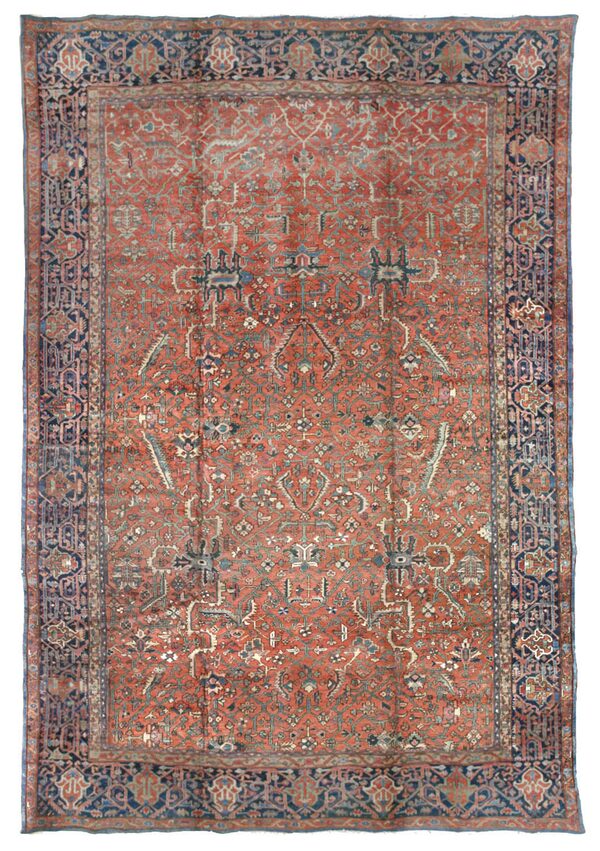
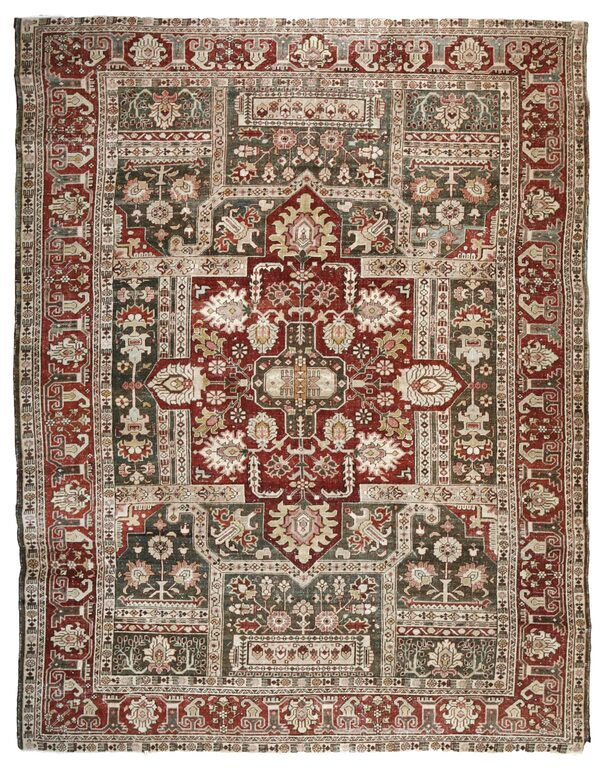
A Heriz medallion often establishes a forceful geometric center, with stepped or angular forms extending into a field filled by branching motifs and corner pieces. Rugs called Serapi may allow more space around the medallion, giving the central form and surrounding vines more room to register independently.
Negative space is not simply empty background. It controls pace, clarifies silhouettes, and determines how the rug reads beneath furniture. A tightly filled field can produce visual energy; a more open field can make equally bold geometry feel calmer.
Follow the drawing rather than counting motifs
The drawing in both traditions converts floral and vine forms into angular, loom-responsive geometry. Compare the thickness of outlines, the length and articulation of branches, the spacing between blossoms, and the way small forms connect to the main structure. Serapi attributions often emphasize a more elongated or spacious handling, but no single leaf or medallion shape is diagnostic.
Read color as a relationship
Color is most useful when read as an organized relationship among field, medallion, corners, borders, and accents. Heriz carpets may use concentrated reds and deep blues to produce strong contrast. Rugs sold as Serapi are often valued for softened terracotta, coral, ivory, blue, and green relationships with more breathing room between them.
Color cannot determine the label by itself. Abrash, fading, pile wear, chemical corrosion, washing, restoration, display history, and photography can all change what the eye perceives. Claims about particular dyes require evidence tied to the individual rug.
Examine borders and corner resolution
Borders reveal how the design was planned and resolved at the loom. Look at the relationship between the main border and guard stripes, the scale of repeating motifs, and how the pattern turns each corner. Small asymmetries or adjustments can be part of the weaving process, while severe discontinuities may also reflect damage or later alteration.
Is a Serapi simply an older or better Heriz?
A Serapi should not be defined as merely an older or better Heriz. Trade usage often reserves the term for admired older carpets with spacious drawing, balanced palettes, and appealing wool, but those preferences do not form a universal certification system. Age and quality must be evaluated independently.
An older rug may have compelling color and drawing while also carrying structural weakness, reduced ends, reworked sides, low pile, corrosion, or extensive restoration. A later Heriz rug may be exceptionally coherent and well made. The label cannot replace direct assessment of artistic and physical integrity.
Fineness also needs context. A comparatively fine weave can support detailed drawing, but knot count alone does not determine beauty, authenticity, condition, rarity, or suitability. In this family, powerful large-scale design may be fully intentional at a lower knot density.
How does WOVEN evaluate a Heriz or Serapi attribution?
At WOVEN, we treat Heriz and Serapi as related attributions that must be earned by the whole object. We begin with the label's intended meaning, then compare the front, reverse, materials, color, condition, and neighboring northwest Persian traditions before deciding how specific the description should be.
- Clarify the label. Determine whether “Serapi” is being used as a period term, a design description, a market category, or an assertion of origin and quality.
- Read the whole composition. Compare medallion scale, field spacing, corner pieces, borders, drawing weight, and negative space.
- Inspect the reverse. Examine knot structure, warp levels, weft passes, foundation, end finishes, selvages, and the clarity of the drawing from the back.
- Separate color from condition. Distinguish woven color variation from fading, wear, corrosion, washing, re-piling, overpainting, or later repair.
- Compare related groups. Review Bakhshaish rugs, Sarab, Karaja, and other northwest Persian weavings when the attribution is uncertain.
- State confidence honestly. “Heriz-area,” “Heriz with Serapi characteristics,” or “attributed to northwest Iran” may be more accurate than an unsupported categorical label.
This sequence preserves the usefulness of connoisseurship without pretending that trade terminology is perfectly standardized. When a decision depends on age, precise origin, authenticity, restoration, provenance, rarity, or value, a qualified specialist should examine the individual carpet.
How do Heriz and Serapi rugs work differently in an interior?
Heriz and Serapi rugs can create different spatial effects even when they share a geometric vocabulary. A densely drawn Heriz can give a room a strong center and concentrated rhythm. A more open Serapi-type composition can carry comparable scale while allowing more of the field color to remain visible around furniture.
We evaluate the rug against the furniture plan rather than assigning either label to a style of room. A large medallion needs enough visible area to remain legible. An all-over or more dispersed design may tolerate interruption by a table. Strong contrast can anchor pale architecture, while a time-softened palette can connect woods, metals, upholstery, and art without feeling recessive.
The broader collection of antique Persian rugs is useful for testing these relationships across different drawing scales. The right choice is not the more prestigious name; it is the individual rug whose proportions, color, condition, and presence serve the room.
What should you ask before buying a Heriz or Serapi rug?
Before buying a Heriz or Serapi rug, ask for the evidence behind the label and enough information to judge the individual object. A confident answer should separate observation from inference and condition from design.
- What does the seller mean by “Serapi,” and how certain is the attribution?
- What evidence supports the proposed date and northwest Iranian origin?
- What are the exact dimensions, including any visible distortion?
- What are the pile and foundation materials, and how were they identified?
- Are the ends and sides original, reduced, rebound, or reconstructed?
- Where are the repairs, reweaving, re-piling, tinting, corrosion, or low-pile areas?
- Can you review full front and reverse photographs plus close-ups in neutral light?
- Does the condition suit the intended placement, furniture, traffic, and maintenance plan?
What is the clearest way to distinguish Heriz from Serapi?
The clearest distinction is terminological: Heriz is the broader northwest Iranian rug family, while Serapi is a narrower trade attribution usually applied to selected older carpets within that tradition. Spacious drawing, balanced color, age, and fine articulation may support the Serapi label, but only a whole-object assessment can determine whether the name is useful, overstated, or uncertain.