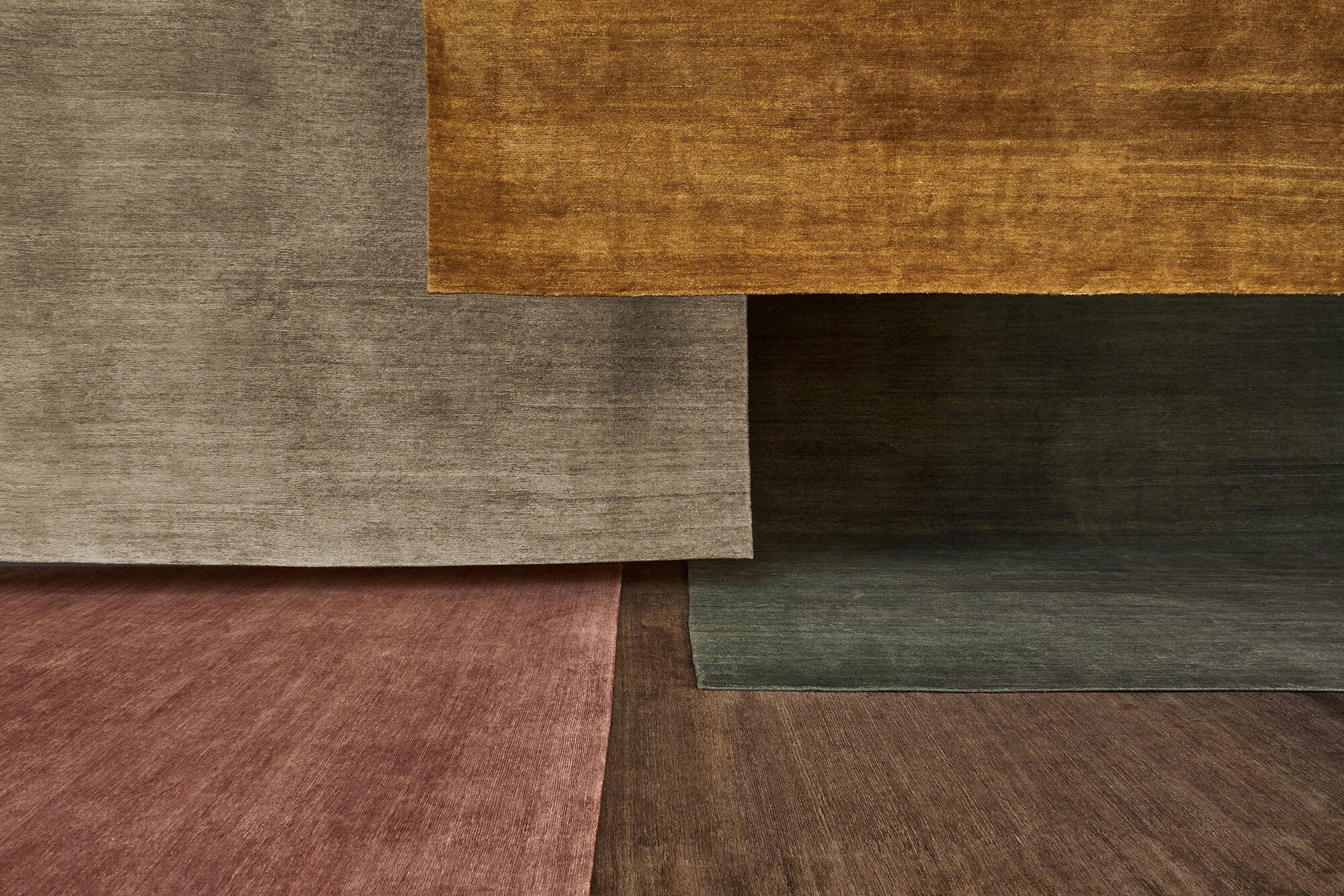
knowledge library / A Designer's Rug Material Guide: Wool, Mohair, Silk, Allo, and Beyond
Wool is often the most adaptable starting point for a luxury home; mohair emphasizes softness and sheen, silk adds luminosity, and allo, linen, or hemp bring a drier texture. The best rug material depends on the room's traffic, furniture, light, and care expectations. Choose the fiber together with its construction and pile, then compare a physical sample beside the room's finishes.
For designers, material is a specification decision as much as an aesthetic one. A wool rug can be quiet and architectural or plush and enveloping. Mohair can add softness and natural sheen. Silk can make a surface luminous and dimensional. Allo, linen, and hemp can bring a drier organic texture. Mixed materials can make a rug feel more nuanced than any single fiber would allow.
Start With the Room, Then Choose the Material
Before comparing fibers, define what the rug needs to do. Is it grounding a living room, softening a primary bedroom, supporting a dining table, warming a library, quieting a gallery, or shaping the first impression in an entry? The same material can behave differently depending on pile, weave, density, color, rug pad, furniture, sunlight, and traffic.
The most useful material brief includes room use, desired hand feel, palette direction, sheen tolerance, pile preference, furniture plan, expected traffic, pets or children, and how much visible variation the client will accept. This keeps the conversation from becoming abstract. A material that is beautiful in a sample may be wrong if it creates too much sheen, too much softness, or too much visual weight for the room.
Which Rug Materials Should You Compare by Room?
A room-based shortlist makes material selection more useful than a universal ranking. Start with the surface the room needs, then test whether its construction and care requirements fit daily use. These are design starting points rather than guarantees that every rug in a fiber category will perform alike.
| Room or condition | Materials to consider | Deciding test |
|---|---|---|
| Everyday living room | Wool in a construction suited to the seating and traffic | Compare feel, pile recovery, visible shading, and the care plan |
| Dining room | A lower-profile wool construction as an initial candidate | Move the actual chair across a sample and confirm spill-care expectations |
| Quiet bedroom | Wool or mohair; silk where its sheen is wanted | Assess barefoot feel and color from both sides of the bed |
| Formal sitting room | Wool, silk, or a documented blend | View the surface from each approach in daylight and evening light |
| Room led by natural texture | Allo, linen, hemp, or a suitable mixed-fiber construction | Check handle, weave, moisture exposure, and care rather than choosing by the natural-fiber label |
A Designer-Facing Rug Material Matrix
| Material | Hand / visual effect | Often useful for | Specification caution |
|---|---|---|---|
| Wool / merino | Warm, resilient, adaptable; can read tailored, rustic, plush, or restrained. | Living rooms, bedrooms, libraries, layered spaces, and many custom starting points. | Construction, pile height, dye, and traffic level still determine suitability. |
| Mohair | Soft, plush, naturally lustrous; WOVEN describes mohair as an angora goat yarn with wool-like durable properties and added softness. | Bedrooms, sitting rooms, refined lounges, and rooms where sheen and softness matter. | Higher pile and sheen may show movement; review use, cleaning expectations, and placement. |
| Silk | Luminous, refined, light-responsive, and often visually deep. | Formal rooms, bedrooms, low-traffic statement areas, and designs where light play is central. | Treat as a considered specification; confirm care expectations and traffic level. |
| Allo / linen / hemp | Drier, organic, matte-to-subtle sheen; natural color movement and texture. | Minimal, textural, tonal, or grounded interiors where surface interest matters. | Fiber, weave, and room use should guide maintenance expectations. |
| Alpaca / angora / cashmere | Silky, soft, warm, and often luxurious underfoot. | Bedrooms, private rooms, and spaces where touch is central to the experience. | Best reviewed through samples because softness, pile, and shedding expectations vary. |
| Goat hair / hemp blends | Earthy, sturdy-looking, tactile, often suited to rustic-modern texture. | Textural rooms, relaxed interiors, and projects needing a more grounded material note. | Verify weave, edge behavior, and client expectations for hand feel. |
| Mixed materials | Balances contrast: matte with luminous, plush with flat, quiet with dimensional. | Custom rugs and Studio WOVEN textures where a single fiber would feel too flat or too strong. | Confirm which fiber dominates the surface and how each material affects care. |
Wool: The Most Adaptable Starting Point
Wool is often the most versatile foundation for a rug because it can take many forms. In one construction it may feel tailored and low; in another, warm, thick, and deeply textural. WOVEN's texture categories include sheared merino, wool tulu, wool loop, wool soumak, wool strata, chunky flatweave, and other wool-led surfaces that show how much construction changes the final effect.
For designers, wool is useful because it can sit quietly in a restrained room or become more expressive through pile, carving, braid, or color movement. A wool flatweave may feel crisp and architectural. A wool tulu can read softer and more enveloping. A sheared wool or merino texture can feel composed and refined.
Maintenance and durability should still be discussed by construction and room use. A low, dense wool rug in a formal room and a higher-pile wool texture in a family space ask different things of the client. Avoid treating wool as one universal answer; it is a material family shaped by weave, pile, finishing, and placement.
Mohair: Softness, Sheen, and a More Sensual Surface
Mohair brings a particular kind of softness and light. WOVEN describes sheared mohair as an angora goat yarn with the durable properties of wool and the added benefit of being extremely soft. In rug form, mohair can feel plush, luminous, and warm without relying on a busy pattern.
This makes mohair especially compelling in bedrooms, lounges, dressing rooms, libraries, and spaces where the rug is meant to be felt as much as seen. A sheared mohair can read dense and refined; a textured mohair or mohair tulu can feel more relaxed and enveloping; a mohair flatweave or braid can bring a subtler kind of surface interest.
Designers should consider how sheen, pile direction, and use will affect the room. Mohair may be beautiful precisely because it moves with light and touch, but that also means it should be presented to clients as a living surface rather than a perfectly static one.
Silk: Luminosity and Visual Depth
Silk changes a rug through light. WOVEN's silk flatweave language points to subtle sheen, hand-spun silk, organic low-cut pile, and light neutral hues; sheared silk is described through luminous pearly neutrals, dense pile, and intricately hand-cut texture. Those qualities make silk a strong choice when the rug needs delicacy, reflection, and depth.
Silk can be especially effective in formal living rooms, bedrooms, low-traffic statement areas, and interiors where material contrast matters: matte plaster against luminous pile, linen upholstery against silk sheen, dark wood against a pale reflective field. It can make a quiet rug feel far from plain.
Silk should be specified with care. Traffic, sunlight, furniture, cleaning expectations, and client tolerance for visible movement all matter. For many projects, silk may be best as a dominant material in a quieter room or as part of a blend where its luminosity is balanced by wool or another fiber.
Allo, Linen, and Hemp: Dry Texture and Organic Character
Allo, linen, and hemp are useful when a room needs texture without too much plushness or shine. WOVEN's allo language describes fibers from the Himalayan nettle plant with low-sheared texture and natural organic color variation. Allo/linen combines entwined strands of allo and linen for organic color movement and subtle texture. Hemp flatweave and textured hemp bring a natural, grounded quality with matte-to-subtle sheen.
These materials can work beautifully in minimal, tonal, rustic-modern, and architecture-led interiors. They can give a room surface interest while staying restrained. They are also useful when the rug should support stone, wood, plaster, leather, or linen rather than compete with them.
As always, application matters. A hemp flatweave, an allo soumak, and a linen low-pile rug are not interchangeable simply because they share a natural feeling. Review the actual sample, edge, pile, hand feel, and intended traffic before making a recommendation.
Alpaca, Angora, Cashmere, and Other Soft Fibers
Fibers such as alpaca, angora, and cashmere bring a more intimate material language. WOVEN's alpaca category describes silky fibers, natural sheen, and fine pile; Mongolian cashmere is described as soft and luxurious with subtle sheen. These materials can be powerful in rooms where comfort, warmth, and touch are central.
They are strongest when the client understands the intended experience. A very soft rug can make a bedroom feel more private, a sitting room more indulgent, or a quiet interior more tactile. But softness is not the only criterion. Designers should review pile, density, shedding expectations, traffic, and cleaning conversations with the rug partner before specifying these materials broadly.
Goat Hair, Jute, and Earthier Textures
Some projects need a more grounded note: a rug that feels earthy, utilitarian, dry, or rustic-modern. Goat hair, hemp-and-goat-hair blends, jute/wool, and related textures can bring that kind of structure. In WOVEN's category language, goat hair is associated with resilient natural texture and earth-toned surfaces; hemp and goat hair flatweaves are positioned as natural Turkish flatweave designs.
These materials can be useful when a room should not feel too polished. They can balance refined upholstery, sharpen a neutral palette, or add a tactile contrast to smooth architectural finishes. The important step is to handle samples and confirm how the texture feels underfoot, especially if the room is barefoot, intimate, or client-facing.
How Mixed Materials Change a Rug's Character
Mixed materials allow a designer to tune the surface of a rug. Wool can stabilize and warm a composition; silk can add light; mohair can soften; allo, linen, and hemp can make the surface drier and more organic. A blend can keep a rug from feeling too shiny, too flat, too rustic, or too plush.
This is where Studio WOVEN's material language becomes especially useful. The most successful mixed-material rugs do not simply combine fibers for novelty. They use contrast to support the design: matte against luminous, flat against raised, dense against airy, smooth against braided. The specification should clarify which material dominates the surface and which material acts as an accent.
Material, Construction, and Pile Should Be Decided Together
Material never works alone. Wool in a flatweave, wool in a high pile, and wool in a soumak construction will feel and perform differently. Silk in a low-cut texture behaves differently from silk used for sheen within a mixed pile. Hemp in a flatweave has a different presence from hemp in a more dimensional texture.
For that reason, a material guide should lead into construction, not replace it. Designers should ask: Is the rug hand-knotted, flatwoven, braided, soumak, looped, sheared, shaggy, or carved? How high is the pile? How much texture is visible from across the room? How will furniture sit on it? How will the material respond to light?
Maintenance Conversations to Have Before Approval
Maintenance guidance should be specific to the rug, not generalized from the fiber name alone. Ask how the material, construction, placement, floor type, rug pad, sunlight, traffic, pets, children, and cleaning expectations affect the recommendation. A material may be appropriate in one room and less appropriate in another because the use case changes.
Before approval, clarify whether the client expects a rug to look crisp and even or to develop visible movement and patina. Discuss vacuuming, rotation, professional cleaning, spill expectations, and whether the surface will show footprints, shading, or pile direction. If a care question depends on the individual rug or floor finish, it should be reviewed by WOVEN or an appropriate specialist.
How Do You Choose a Rug for a Contemporary Home?
Choose a rug for a contemporary home by deciding whether it should introduce history, lead with pattern, or support the room through texture. Antique rugs, contemporary patterned rugs, and tonal textural rugs can each work with modern architecture. Their age or style label matters less than the relationship among furniture scale, visual contrast, surface, and light.
| Design direction | What it contributes | What to test |
|---|---|---|
| Antique or vintage | Patina and a counterpoint to new architecture | Actual dimensions, visible border, color hierarchy, and condition |
| Contemporary pattern | A graphic focal point or a rhythm shared with the furniture | Pattern scale beneath the furniture and competition with art or upholstery |
| Tonal texture | A quieter field shaped by pile, yarn, and reflected light | Whether the full surface has enough depth, and how directional sheen changes the color |
For a room with expressive stone and large artwork, begin by testing a restrained rug. For a room of quiet upholstery and plain walls, test whether pattern or an antique composition supplies the missing focus. These are design judgments to compare in the room, not rules tied to a period. Use the focused guide to choosing an antique rug for a contemporary interior when a found piece leads the shortlist.
How to Choose the Right Material for the Room
Choose wool when the project needs adaptability, warmth, and a broad range of construction possibilities. Choose mohair when softness and sheen are central to the mood. Choose silk when luminosity and visual depth matter more than rugged practicality. Choose allo, linen, or hemp when the room needs a drier organic surface. Choose alpaca, angora, or cashmere when private comfort is the point. Choose mixed materials when no single fiber gives the room enough nuance.
The best material choice feels inevitable once it is in the room. It supports the architecture, fits the furniture plan, respects the client's life, and gives the surface exactly the amount of texture, sheen, softness, and depth the space can carry.
FAQ
What is the best rug material for a living room?
There is no single best material for every living room. Wool is often a strong starting point because it can be adapted through weave, pile, and finish, but the right choice depends on traffic, furniture, palette, pets, sunlight, and maintenance expectations.
Are silk rugs practical?
Silk can be beautiful in the right room, especially where luminosity and refinement matter. It should be specified with care, considering traffic, furniture, cleaning expectations, and whether silk is used alone or as part of a blend.
What does mohair add to a rug?
Mohair adds softness, plushness, and natural sheen. It can make a rug feel more tactile and atmospheric, especially in bedrooms, lounges, and quieter rooms.
Why use mixed materials in a rug?
Mixed materials can balance qualities that a single fiber cannot provide alone: matte and luminous, flat and raised, soft and structured, quiet and dimensional.